
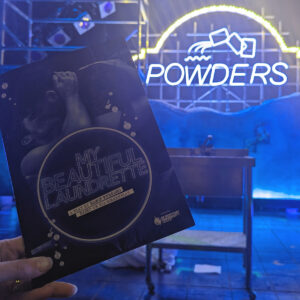
It’s confession time! I have never seen My Beautiful Laundrette written by Hanif Kureishi. Neither the film nor the 2019 Made at Curve production so I had no idea what to expect. All I know is that, when it was announced at Curve’s season preview night last year, the reaction from the audience suggested it was something I would miss if I didn’t see it this time so I booked my tickets – for the front row of the studio – and I was so chuffed I did.
The story covers many strong aspects of life in the 1980s. These were my childhood years and, living in “Little Italy” on the edge of an area called Little Bangladesh/India/Pakistan (depending on which part of the road you were in) due to the numbers of families who had not long arrived in England, I remember seeing from a sideline some of the issues that My Beautiful Laundrette covers. Racism, homophobia, the role of women were all prevalent and helped to drive both division and unity in my childhood years and were all well covered in this latest Remade At Curve production and it is set against a musical background written by one of my favourite groups ‘back in the day’ – Pet Shop Boys.
The set and costumes, designed by Grace Smart, is beautifully complimented by Ben Cracknell’s lighting and both work very cleverly together to differentiate between the various settings whilst reminding us all that the one constant behind it all is the laundrette that Omar (Lucca Chadwick-Patel) and Johnny (Sam Mitchell) are turning into something special.
At times laughing and at others feeling completely uncomfortable the audience travel the journey of Omar and Johnny as they come to terms with who they really are and the impact that that discovery has. As the racism flows from the far right element of Genghis (Paddy Daly) and Moose (Emma Bown) that Johnny was so involved with in his youth there is also a reciprocal racist undertone from the Pakistani element of Nasser (Kammy Darweish) and increasingly intimidating Salim (Hareet Deol – that sculpted ‘tash!) as they deride the work ethic and superiority complex of the English – both elements of which add to the confusion for Omar on his way to work out where he actually sits in English society – a journey that I saw so many of my childhood friends taking as first or second generation settlers in the UK. The bad language that runs throughout the show is testament to the times as well – highlighting the derision both factions have for each other.
My only slight niggle was the almost too-easy way that Johnny put aside his hatred of the ‘other side’ to enter into his sexual relationship with Omar. Omar was the person he bullied at school, the race he had marched against and railed against yet there was almost no resistance or confusion from him about entering into this relationship in a time when homophobia was rife. This was more down to the writing than the performance though and didn’t really detract from the performances.
The gentle yet powerful way that the production, directed originally by the inimitable Nicolai Foster and this time by Nicole Behan, covers these disturbing undertones is done so well and, from a female point of view, the futility felt by Tania (Sharan Phull) as she rages against the prospect of an arranged marriage really hits home. She was initially desperate for Omar to marry her so she can be who she wants to be whilst allowing him cover for who he wants to actually be with before finally running away to start a new life elsewhere. Sharan really does hit us in the feels with her performance testing the water and pushing the boundaries – something we have all done in our youth.
Whilst there were machinations, plotting and manoeuvrings to get ahead in the world my sympathies laid firmly at the feet of Tania (for the reasons mentioned above) and Papa who had been something in Karachi and then, basically, became a victim to the discrimination that turned him into an alcoholic nothing. This resulted in his wife’s suicide due to his inability to deal with the plummet from a person of importance although, obviously, the fact that he abused her physically added to the unacceptable battle that women, especially Muslim women, still face in so many circumstances 40 years later.
The entire show has so many elements that still ring true today especially as events in the world are increasing the numbers of hate crimes reported and there is a rise in far right activity. It seems that the hope that we are left with at the end of the show as Johnny and Omar finally feel comfortable in each other’s company is destined to be short-lived.
The fact that so many of the 2019 cast have returned to this new revival is testament both to the power of the story and to their talents and it was especially heartwarming somehow when I read in the programme that Gordon Warnecke, who played the vodka riddled Papa, had been Omar in the original film 40 years ago. Almost like a coming of age if you get my meaning.
My Beautiful Laundrette runs at Curve Theatre, Leicester until February 24th.




Leave A Comment
You must be logged in to post a comment.