
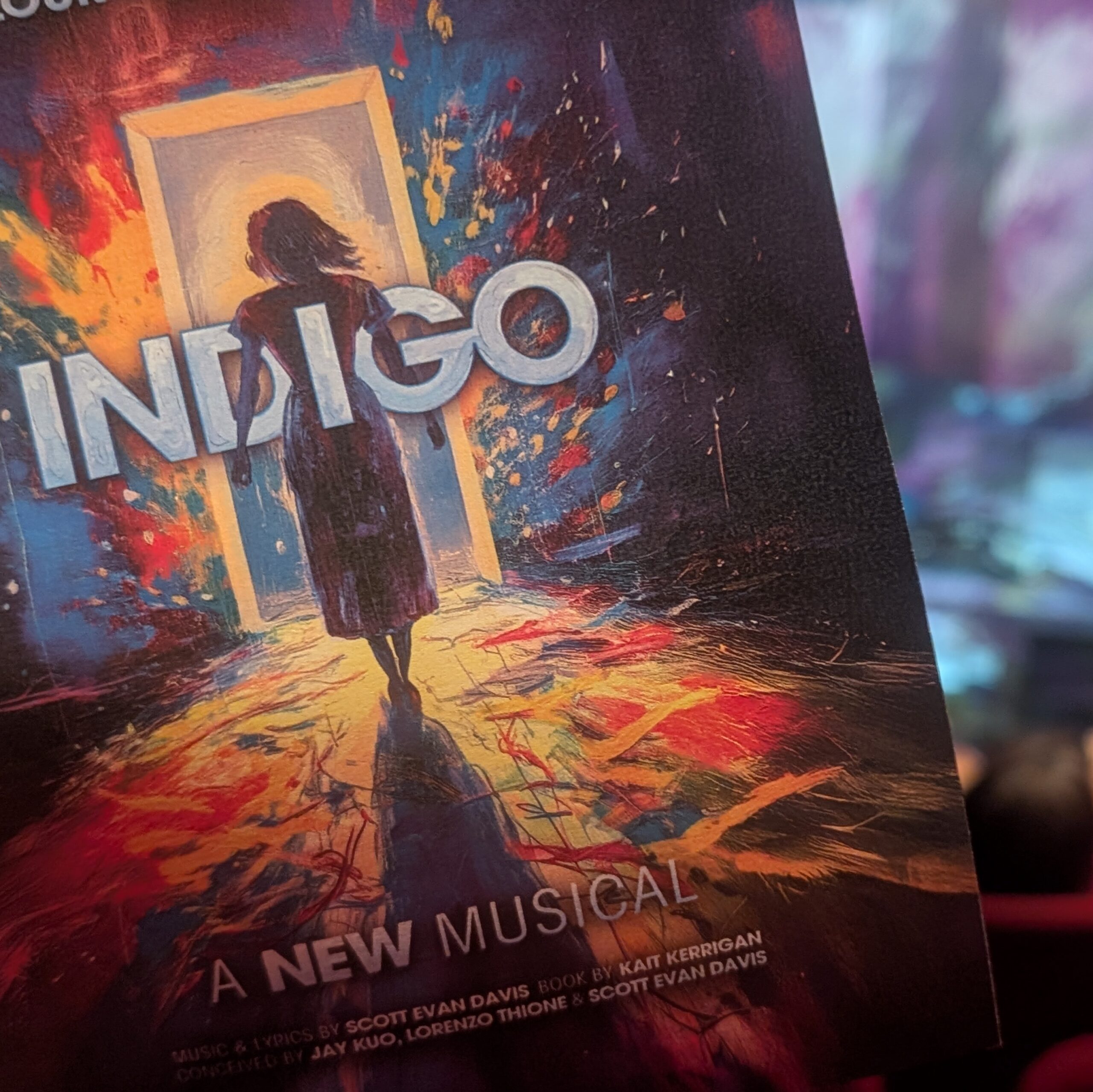
Over the past few months Indigo, written by Kait Kerrigan and music/lyrics by Scott Evan Davis and conceived by Scott along with Jay Kuo and Lorenzo Thione, has come up in conversations time and again when I have visited Curve Theatre, Leicester. The concept, a snippet of the music and a couple of the cast were at the theatre’s Season Preview back in May and it sounded intriguing – especially for an ADHD mum of ADHD/ASD children. The concept was simple – a non-verbal young lady with Autism and synaesthesia in a dysfunctional family with a Grandmother with early onset Alzheimers – however putting that concept into reality without being patronising, over-simplistic or enabling wasn’t an easy thing to get my head around and I did not envy director Catie Davis’s job in creating this piece – but what an amazing job she did.
A month or so later Indigo came up again in conversation when our eldest son (17 year old with ADHD) applied to do some work experience at Curve and the opportunity came up for him to work for a week with the lighting department on the creation of Indigo. Given his neurodiversity it seemed a very apt fit and the team there looked after him brilliantly. He came home buzzing every night telling us snippets of the things he had been doing and the intrigue in me grew and grew so we booked tickets for him, his older sister and his dad and I to go and see what it was all about – and, boy, am I glad I did.
Last night saw us in the Studio as we duly took our seats, marvelling at the chaotic set on stage which was splashed with paint swirls and colours, canvas flats, boxes and a living room obviously in the early stages of having someone move in before the colours faded into the humdrum and beige flatness of the home of Beverley (Rebecca Trehearn) and Rick (Nuno Queimado) before their lives get turned upside down with the arrival of Beverley’s mum and daughter (separately).
All of the cast were superb in their parts, bringing an understanding to each of their roles with ease, comfort and amazing vocal talents however special mention MUST go to the first character we are introduced to: 16 year old Emma, brilliantly played by Katie Cailean on what I understand is her professional debut (I was gobsmacked when I heard that!) , as we are let into Emma’s mind and she sings to us about her colours of home and the peace of the colours she sees when her dad (unseen but shown in art) comes home. The peaceful serenity in her head of colours interpreting her way through life. This very rapidly takes a turn into the red when we see the suggestion of her dad having a heart attack, the fear that situation brings is vividly portrayed by Emma and sets the scene for her future – back to a mother who, at a young age couldn’t cope with her and walked away, trying to forget the ‘awful’ decisions of the past. Much of the show is underpinned by the musical prowess introduced by Brad Haak and led by musical director Jenny Deacon-Say. When not showing us her mental thoughts through song Cailean’s portrayal of Emma as the world sees her is so accurate to many of the autistic young people I have met and the portrayal was gentle, compassionate and filled with understanding.
I won’t go into too much detail about the plot as I don’t want to put any spoilers in place but I would rather tell you about the understanding, the resonance and the connection with this piece or art – for that is what it is – in terms of the set, the lighting, the performances and, well, everything.
I mentioned the set earlier – designed by Andrzej Goulding – it is chaotic yet very clever as it transforms from lounge, to park, to escapism, to fear and a place in our heads that we can’t usually see, describe or understand – but it is strangely inviting to my neurodiverse mind. I understood the chaos, I understood the apparent lack of uniformity because that is exactly how my head works. Spinning constantly, living in chaos but knowing where things are within that chaos.
The marriage between Goulding’s set and the lights, sound and costumes (designed by Jake DeGroot, Matt Peploe and Susan Kulkarni respectively) is sublime. The canvas flats are used as projection screens to show us the colours of Emma’s mind; the way she sees people as colours – her grandmother Elaine (Lisa Maxwell) in pink, her social worker Alicia (Tania Mathurin) in a gentle amber and her new friend, Tyler (Hugo Rolland) in vibrant yellow as he struggled to understand what I believed was his own undiagnosed ND mind (dyslexia maybe?) – splashed onto those canvases as we see into her way of thinking – chaotic, bright, continually moving, changing, blurring – it was just so right somehow. Personally, I live my life in pictures. People talk to me and a design pops into my head (a brilliant skill for my design and photography businesses admittedly but it can be distracting in the middle of a conversation!) and I can’t explain how but it fits somehow. It feels like a moment of clarity in the madness when I see the finished picture in my head – a bit like it felt Emma’s head was portrayed. The entire show just felt ‘right’ and I have learned, from this show, that there is a name for what happens in my head – synaesthesia – so Indigo has helped me understand myself a little more.
I can imagine that, for some people watching the show, it could be a bit overwhelming with so much going on however it is necessary. In a neurodiverse mind that is exactly how it is sometimes – nothing focuses, everything keeps shifting, mind constantly darting to and fro trying to make some sense in the madness – and for a neurodiverse mind it is often constant overwhelm and this was portrayed so powerfully that it took me nearly an hour after the show to process everything I had seen and heard as I sat, mentally, on the edge of an emotional avalanche.
It is a powerful piece and it hit home so many times – especially when Alicia tells Emma’s mum, Beverley, that we have to take the good with the bad. This struck such a chord with me because, as a parent of neurodiverse youngsters I often feel completely alone and isolated, like we aren’t valid somehow, and that I’m not good enough because I struggle,I fall, I ‘fail’, over and over again. beating myself up because of my reaction, my lack of patience, my lacking as a parent because the bad times seem so much more prevalent than the good and it is exhausting. THIS is why this piece of theatre is so good. I connected with it in almost every facet and I felt heard. THIS is why I believe this piece should travel – take the message round the country – connect with so many people who feel lost and alone. Show them that it will be okay – there is light and colour in the darkness.
I thank Curve Theatre, the creatives involved, the crew and those people on stage for allowing us into that head space; for giving our own internal struggles a chance to be seen and for trying to portray to the world of neurotypicals why acceptance, understanding and tolerance are so very important.








Leave A Comment
You must be logged in to post a comment.